You are holding a sleeping newborn and you are terrified to put them down. Not just because they'll wake up — but because you've half-read fourteen different things online and now you're not sure if the way your baby is sleeping right this second is okay.
This post contains affiliate links. We may earn a small commission at no extra cost to you.Take a breath. Here's everything you need to know about safe sleep for newborns, in plain language, with zero judgment.
TL;DR: The Safe Sleep Basics
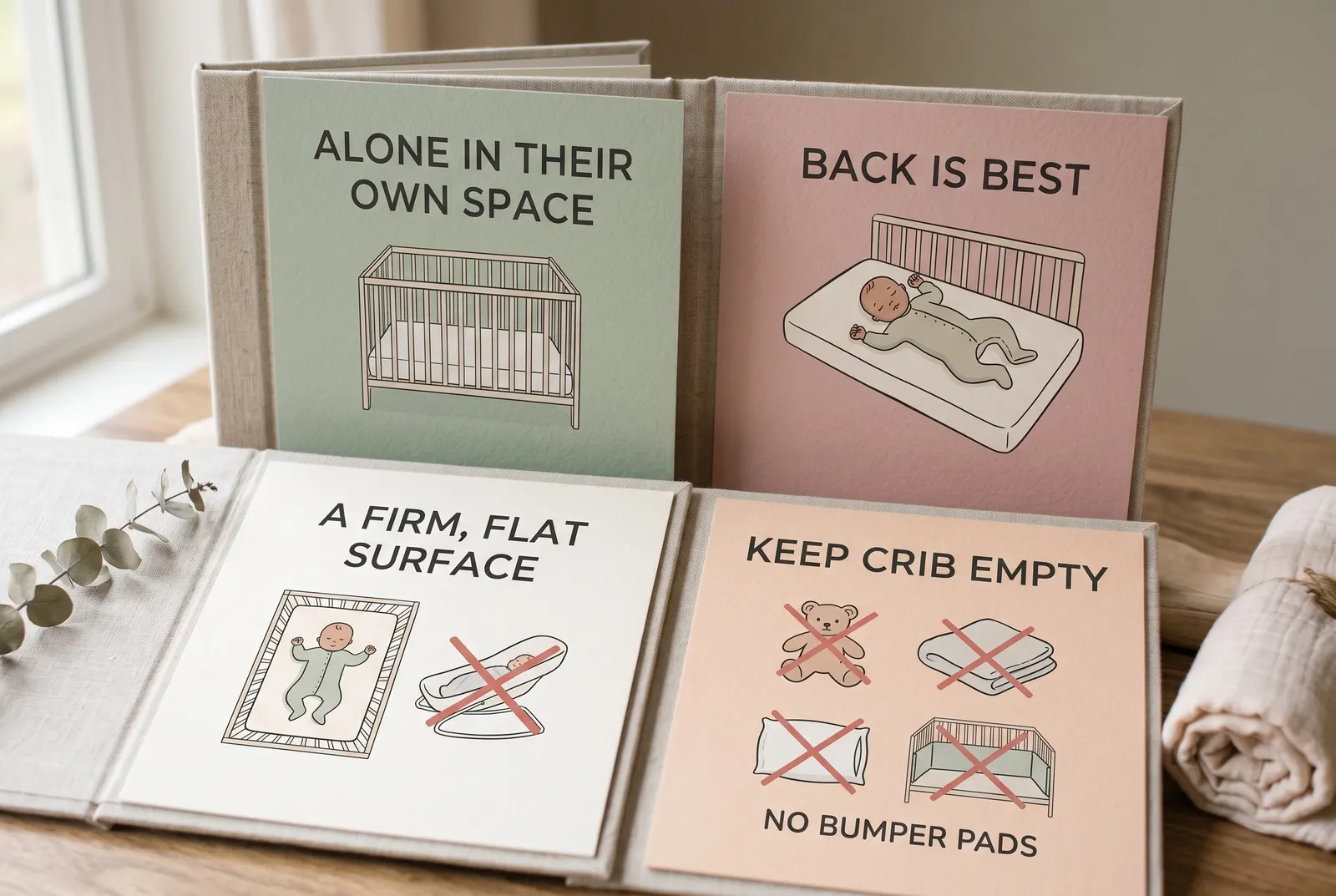
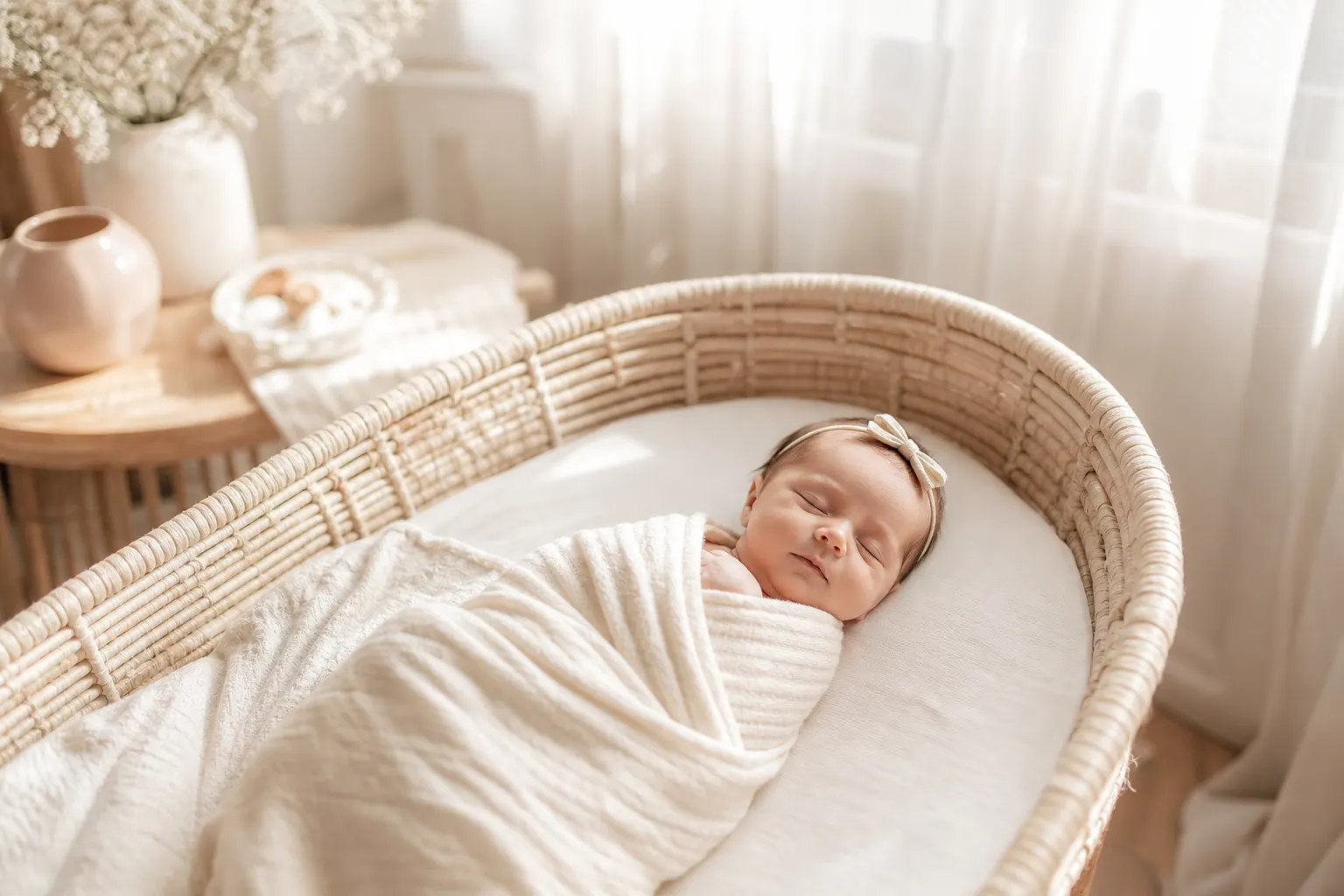
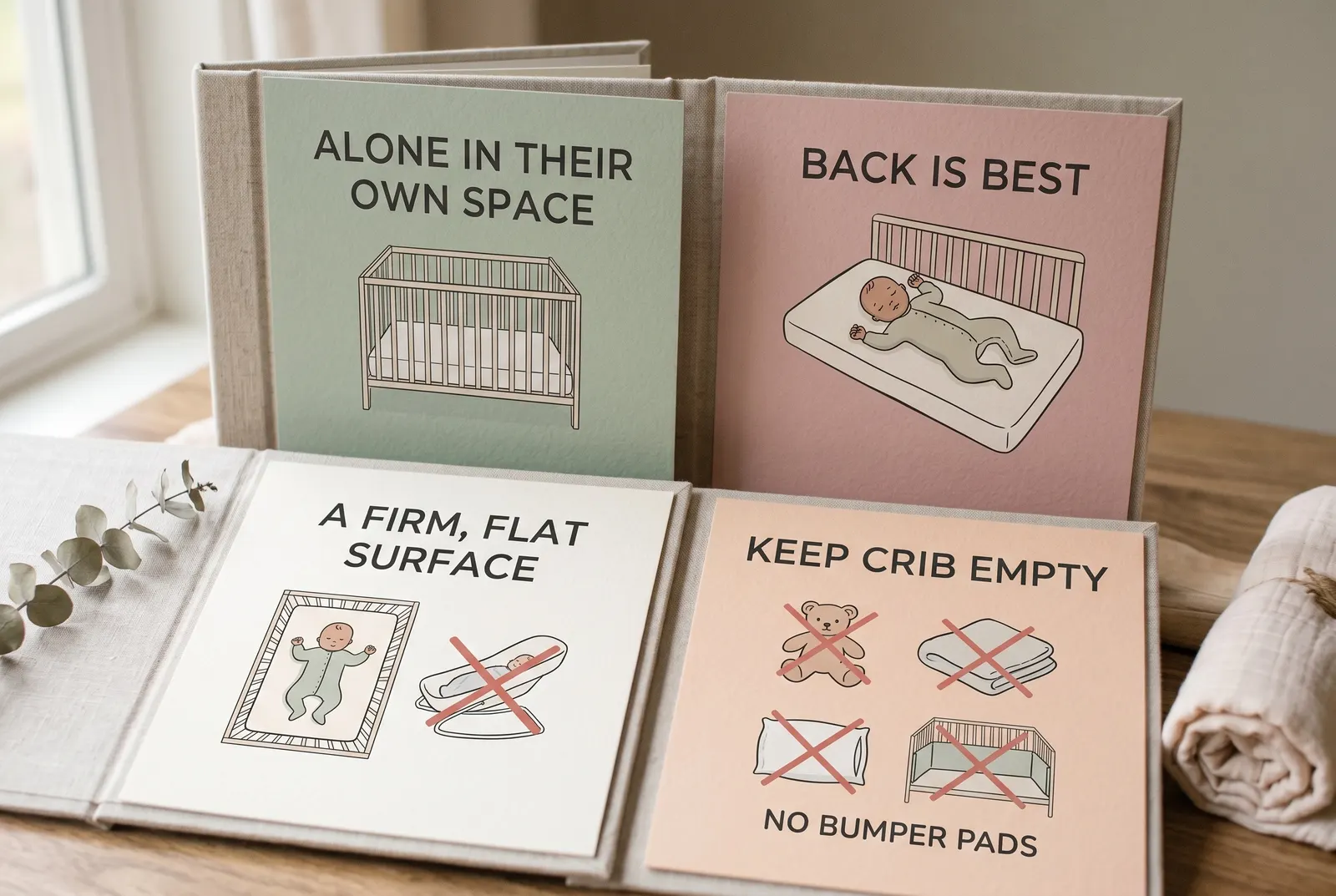
The American Academy of Pediatrics recommends: baby sleeps alone, on their back, on a firm flat surface, in your room for the first six months. No loose bedding, no bumpers, no pillows. A firm mattress with a fitted sheet is the whole setup.
The ABCs of Safe Sleep
The AAP built their guidance around a simple framework: Alone, on their Back, in a Crib (or bassinet). It's a starting point, not the full picture — but if you're overwhelmed, those three things are your anchor.
It also helps to know why these rules exist. SIDS (sudden infant death syndrome) and other sleep-related infant deaths are most often caused by positional asphyxia — baby ending up face-down in soft bedding, or having their airway restricted by something in the sleep space. The rules aren't arbitrary. They're based on decades of data.
What "Alone" Actually Means
"Alone" means baby has their own sleep surface — not your bed, not the couch, not propped in a bouncy seat overnight. It does not mean baby has to be in a different room. Room-sharing without bed-sharing actually lowers SIDS risk for the first six months, which is why the AAP recommends it.
If you fall asleep nursing or bottle-feeding in bed — which, let's be honest, literally every parent does — move baby to their safe surface as soon as you can. You're not a failure. Just keep the safe surface close so it's easy.
Setting Up a Safe Sleep Space
You don't need to spend a lot of money to do this right. Here's what the surface actually needs to be: firm, flat, and free of loose items.
A Halo Bassinest is popular because it swivels right up to your bed, making nighttime feeds easier without bringing baby into your bed. It's a genuine convenience item, not just marketing fluff.
A standard crib with a firm crib mattress works just as well. Any basic model meeting current safety standards is fine. A simple waterproof crib mattress and two fitted sheets is your entire bedding setup. That's it.
A pack-and-play with the infant bassinet insert also works and travels with you. Versatile, practical, genuinely useful.
Crib vs. Bassinet vs. Pack-n-Play
Bassinet: Best for the first three to four months. Small footprint, easy to move room-to-room, sits at bed height. Most have a weight limit around 15–20 lbs, so you'll transition to a crib eventually. Crib: The long-term solution. Baby can use it from birth through toddlerhood. More setup, more space, but you won't need to buy anything else. Pack-n-Play with bassinet insert: The flexible option. Works for travel and doubles as a play yard later. The infant insert is safe for newborns; the main play yard is not a safe sleep surface without the insert.What Never Goes in the Crib
This is where well-meaning relatives cause chaos. Here's the list of things that should not be in baby's sleep space:
- Loose blankets (including the soft one grandma knitted)
- Bumper pads (padded, mesh, or otherwise — none of them)
- Pillows
- Positioners or wedges
- Stuffed animals
- Sleep positioners marketed to prevent rolling
Safe Sleep Myths That Need to Die
A lot of bad advice gets passed down as wisdom. Here are the ones that come up most:
"My baby sleeps better on their stomach." This is true for many babies — and it's still not safe for unsupervised sleep. Back sleeping is protective specifically because a baby on their stomach can't move their head away from a restricted airway the way an older child can. "A little loose blanket is fine if I tuck it in." Babies move more than you think, even newborns. Tucked blankets don't stay tucked. Use a sleep sack instead. "Bumpers prevent injuries." The research doesn't support this. The risk of entrapment and suffocation from bumpers outweighs any theoretical benefit. Most pediatric hospitals and the AAP agree: skip them."My Baby Hates Sleeping on Their Back"
Many do, at first. A few things that actually help: swaddling tightly before laying them down, making sure they're deeply asleep before transferring, and warming the sleep surface for a minute with your hand before you put them down (remove any heating pad before baby goes in). It takes a few weeks for most babies to stop startling awake on their backs. It gets easier.
If you're navigating this alongside the chaos of newborn nights, the guide on getting more sleep without sleep training your newborn covers the realistic middle ground most parents end up in.
FAQ
How long do I need to follow safe sleep rules?
The AAP safe sleep guidelines apply for the first 12 months. SIDS risk peaks between one and four months and drops significantly after six months, but the guidelines extend to a year because sleep-related infant deaths of all causes remain possible. Most parents shift to more relaxed practices naturally as baby grows and gains head control.
Is a DockATot or Snuggle Me safe for overnight sleep?
No. These are lounger-style products with soft, padded sides — they don't meet AAP safe sleep standards for overnight or unsupervised sleep. They're fine for supervised lounging while you're sitting right there. For sleep, use a firm flat surface with no soft surroundings.
My baby only sleeps in the car seat or bouncy seat — is that okay?
Car seats and bouncy seats are not safe sleep surfaces for extended or overnight sleep. The semi-reclined position can cause their head to fall forward and restrict their airway — especially in newborns with limited head control. If baby falls asleep in a car seat during a drive, that's okay. But transfer them to a flat, firm surface when you're home and not driving.
---
Mamawoo is a community of real moms sharing real experience — not medical advice. Talk to your pediatrician about your specific baby's sleep needs.